
Proactively manage cloud spending.

FinOps is an evolving cloud financial management discipline and cultural practice that enables organisations to get maximum business value by helping engineering, finance, technology and business teams to collaborate on data-driven spending decisions.
At its core, FinOps is a cultural practice. It is the way for teams to manage their cloud costs, where everyone takes ownership of their cloud usage supported by a central best-practices group. Cross-functional teams in Engineering, Finance, Product, etc. work together to enable faster product delivery, while at the same time gaining more financial control and predictability.
FinOps is the practice of bringing a financial accountability cultural change to the variable spend model of cloud, enabling distributed engineering and business teams to make trade-offs between spend, cost, and quality in their cloud architecture and investment decisions.
Cloud spend can drive more revenue, signal customer base growth, enable more product and feature release velocity, or even help shut down a data center. FinOps is all about removing blockers; empowering engineering teams to deliver better feautres, apps, and migrations faster; and enabling a cross-functional conversation about where to invest and when.
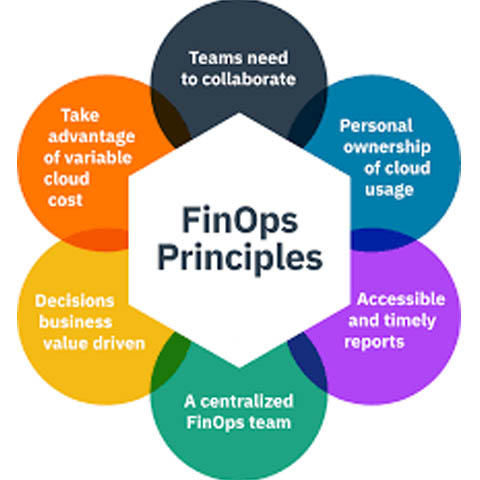
• Proactively manage cloud spending
• Bring financial accountability and predictability to cloud costs
• Break down silos to increase cost-conscious culture
• Manage spending and usage for multiple clouds at scale
Drive Financial accountability and cost-conscious culture at the intersection of finance, business, and technology.
Managing cloud costs can be complicated. In traditional IT financial management, consumption was controlled by a centralised, capital expenditure (CapEx) procurement process. However, this model is restrictive, and businesses are looking to innovate at the pace necessary to remain competitive in todays' digital world. In addition to the fundamental change from CapEx to Operational Expenditure (OpEx), the consumer-driven nature of cloud creates a situation where traditional, centralised financial governance processes are often bypassed. In exchange for convenience, ease of use, and faster innovation, organisations are sacrificing financial control.
It is easy to overspend on cloud services. Constant changes in pricing models, variable pricing, and a lack of standardisation in cloud billing make it difficult to budget and forecast for your organisations' unique requirements. With consumption driven by the users themselves, accountability can be sporadic. In this new, cloud-enabled world, costs tend to be managed reactively. If business does not respond, the result can be significant wasted expenditure. Reactive cost optimisation is a cycle that tends to repeat itself, leading to stagnant innovation and uncertainty about the ability to manage cloud as the business need it to be.
A new way of working is needed. That new way of working is called Financial Operations, driving sustainable and systemic change in the way we manage IT usage and spending.
Quantum Cloud Technologies FinOps has been designed to optimise your cloud investments by bringing together financial, technical, and business functions to drive financial accountability and create a cost-conscious culture in your enterprise. Quantum Cloud Technologies solution will help you achive the desired business outcomes of digital transformation by leveraging the expertise, experience, proven methodology, and assets of Quantum Cloud Technologies to assist your business sustainably manage spending and usage for multiple clouds at scale.
Quantum Cloud Technologies puts emphasis on the importance of transparent visibility in creating awareness and driving the cultural transformation, and on the systemic changes needed to operationalise FinOps for the long term. Our approach begins with a diagnostic assessment and helping establish stakeholder alignment by developing a case for change and the roadmap to success. With stakeholder commitment and the roadmap in hand, we work with you to traverse the journey to FinOps.
The Quantum Cloud Technologies FinOps engagement framework is designed to develop a sustainable FinOps capability, with the flexibility to meet you wherever you are on your journey to cloud and adoption of FinOps. We draw from our experience to encourage best practices, like building support early in the the program through the adoption of the FinOps operating model with a pilot group of users in a common cost center - a pilot that both proves the business case and provides insight into the sustainability of the target operating model.

• Finance, technology, product, and business teams work together in near real time as the cloud operates on a per-resource, per-second basis.
• Teams work together to continuously improve for efficiency and innovation.

• Unit economic and value-based metrics demonstrate business impact better than aggregate spend.
• Make conscious trade-off decisions among cost, quality, and speed.
• Think of cloud as a driver of innovation.

• Accountability of usage and cost is puched to the edge, with engineers taking owenership of costs from architecture design to ongoing operations.
• Individual feature and product teams are empowered to manage their own usage of cloud against their budget.
• Decentralise the decision making around cost-effective architecture, resource usage, and optimisation.
• Technical teams must begin to consider cost as a new efficiency metric from the beginning of the software development lifecycle.

• Process and share cost data as soon as it becomes available.
• Real-time visibility autonomously drives better cloud utilisation.
• Fast feedback loops result in more efficient behaviour.
• Consistent visibility into cloud spend is provided to all levels of the organisation.
• Create, monitor, and improve real-time financial forecasting and planning.
• Trending and variance analysis helps explain why cost increased.
• Internal team benchmarking drives best practices and celebrates wins.
• Industry peer-level benchmarking assesses your companys' performance.

• The central team encourages, evangelises, and enables best practices in a shared accountability model, much like security, which has a central
team yet everyone remains responsible for their prortion.
• Executive buy-in for FinOps and its practices and processes is required.
• Rate, commitment, and discount optimisation and centralised to take advantage of economies of scale.
• Removing the need for engineers and operations teams to think about rate negotiations, allowing them to stay focused on usage optimisation
of their own environments.

• The variable cost model of the cloud should be viewed as an opportunity to deliver more value, not as a risk.
• Embrace just-in-time prediction, planning, and purchasing of capacity.
• Agile iterative planning is preferred over static long-term plans.
• Embrace pro-active system design with continuous adjustments in cloud optimisation over infrequent reactive cleanups.